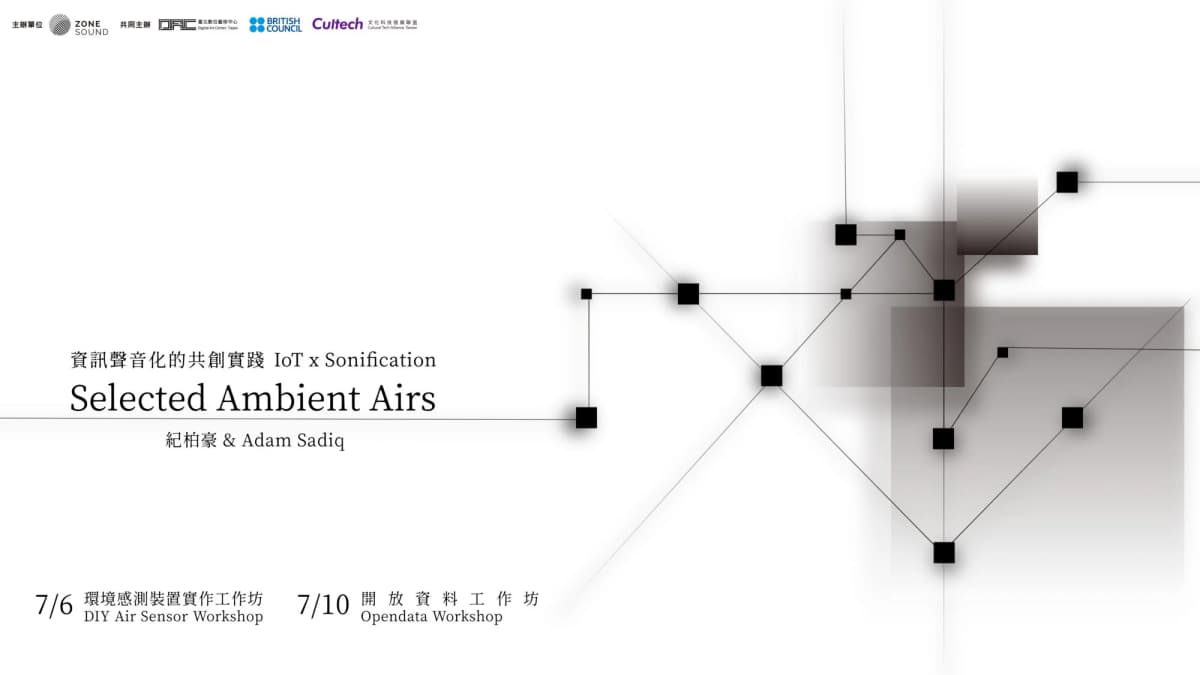
“Selected Ambient Airs” is a project that connects environment, technology, and arts by developing an environmental monitoring network and sonification practices. It enables participants to learn about open data, basic electronic circuits and microcontrollers in the methods of “making” and “playing” by applying creative technologies to connect to the Internet, explore data, activate music, and bridge the gap between creative communication and social interaction amongst people. This project is part of the continuation of the cooperation with the British Council and FACT Liverpool. Taipei Digital Arts Center and the Culture Tech Alliance are studio and venue providers and collaborative planners.
In this program, we apply various technology products to collect environmental data through sensors as a source to sequence rhythms and melodies, to guide algorithms and to alter timbres. By proposing new ideas for existing technologies, from signal processing, IoT device to sonification enables us to cross the thresholds of different disciplines. Making and playing appear to be appropriate ways to blur the line between creators and the audience that encourages more people to become creators. Both of them are essential ingredients to establish audience participation while growing the seeds of co-creation. By building on a series of resources created across disciplinary boundaries, we are aiming to connect natural systems, namely those of weather and air quality, with compositional approaches in generative media. A fundamental aspect of this approach is that we are dealing with phenomena that are mostly unseen and which are both scientific and emotional in content.


Using sound to reorient our perception of the world around us is a way to correspond to Ocular-centrism. When we think of issues like pollution and climate change, imagery readily springs to mind about chimney stacks, glaciers, and busy roads, which readily colonizes and fatigues our perceptual register for comprehending these issues. This project is trying to state the question in another way to relieve our understanding of visual bias and perhaps through ambient music bring nature and our environments closer to us. By sampling air sources we see a continuity in the process of translating these data patterns into sound or vibration, to quote Steve Goodman (Kode 9) “If we subtract human perception, everything moves.”
The environment monitoring module is designed to be open-source, affordable to build, and comes with a free operating platform so that it could be accessible for schools and interested citizens in future projects. To highlighting the diversity and differences by giving access to existing data can hopefully make it easier for people to engage with issues, have fun with the process, collaborate with others and feel positive about taking initiatives.

STEP 1 – IoT Environmental Sensor
For this showcase, we have developed an open-source project to create an environment monitoring module that samples the surrounding air and other data at regular intervals. These modules have been placed around Taipei city to index various environmental sources for us to use as the trigger for signal processing and learning approaches.
STEP 2 – Create the OpenData
The environment sensor module gathers data from its environment and publishes over MQTT in Node-RED. We can create our dataset from those environmental data transmitted from sensor modules and give access to others with a simple GUI interface. In another word, everyone can download the environmental monitoring data with the Internet, as well as contribute a new node according to the provided specifications.
STEP3 – Sonification Experiments